

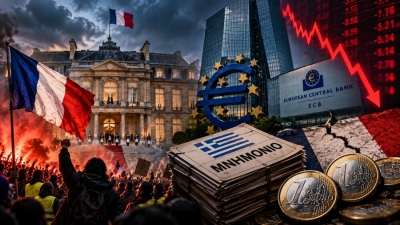
With political instability, social rage, and rising borrowing costs in France in the background, fears of a new debt crisis are intensifying. Yields on French bonds are moving at levels causing alarm, the Paris stock exchange faces heavy pressure, and the government of Sébastien Lecornu is called to manage a difficult fiscal impasse while thousands of citizens demonstrate against high prices and political paralysis. Strict reforms on the table mirror those applied in Greece, Portugal, and Ireland during the Eurozone crisis, while an intervention by the European Central Bank remains possible under specific conditions. "Either bond markets will revolt, or the people, or both," warns Mike Bell of RBC BlueBay Asset Management, describing the explosive dilemma facing Paris.
French bonds
The yield on the French 10-year bond rose by more than 10 basis points, remaining near its highest level in decades despite a recent de-escalation. Higher yields translate into increased borrowing costs for the government in the bond market. Yields on 2-year and 30-year French bonds advanced by 6 and 8 basis points, respectively. Equities also face pressure, with the CAC 40 index falling 1.34% in morning trading on Monday (10/19/2026). In recent years, the French stock market has posted significantly weaker performance compared to other European markets, despite only about 15% of listed companies' revenues originating from the domestic market. The banking sector faces particularly severe pressure.
The French stock market is traditionally sensitive to any widening of the so-called "OAT-Bund spread"—the difference between the yield on French government bonds and that of corresponding German bonds. This spread has reached its highest level since the European sovereign debt crisis of the early 2010s. French bond yields now exceed even those of Italy or Greece, indicating that investors perceive an elevated risk.
The widening yield spread sparks concerns regarding corporate capital-raising costs and reinforces fears of higher taxes and tighter regulation of economic activity. Simultaneously, the French stock market faces headwinds due to the heavy weighting of luxury goods companies, which suffer from declining consumer spending on high-end goods in China.
"Either bond markets will revolt or the people"
Hundreds of thousands of people demonstrated over the weekend, protesting political paralysis, the cost of living, and the state of public services, including schools and healthcare. Mass gatherings in cities from Paris to Lyon and Marseille were accompanied by dramatic scenes, with buildings and cars engulfed in flames, clashes with police, and more than 2,000 arrests.
"If you are an international investor considering investing in French bonds, this situation does not help," stated Mike Bell, head of market strategy at RBC BlueBay Asset Management, on CNBC's Squawk Box Europe. "It seems that either bond markets will revolt, or the people, or both sides," Bell added. Foreign investors hold an increasingly large share of French public debt. Their share rose from approximately 48% at the start of 2022 to nearly 60% by early 2026, a factor that may lead to greater bond market volatility during periods of risk aversion.
"What France needs is to put its finances in order. It must raise the retirement age. You cannot retire at 62 when average life expectancy reaches 84 years. But if all this happens before they even begin discussing such a measure, imagine what would happen on the streets of France if they attempted to raise the retirement age. In Britain, for instance, it stands at 68 years," Bell added. "This situation does not make the country look particularly easy to govern at a time when hard decisions must be made."
The budget challenge
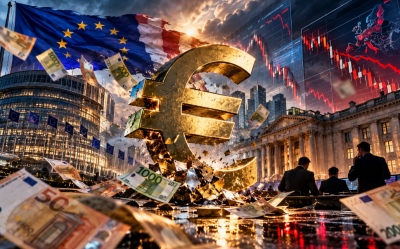
France's borrowing costs, as reflected in benchmark sovereign bond yields, touch their highest levels since 2002, as investors demand higher compensation to fund the country's public spending. Primary sources of concern include uncertainty ahead of next year's presidential election—where far-right Marine Le Pen leads in multiple polls—and whether Prime Minister Sébastien Lecornu's minority government will succeed in passing the 2027 budget currently under negotiation.
Budget negotiations are becoming increasingly difficult in France and have already led to the downfall of two of Lecornu's predecessors. Analysts estimate creditors demand a strong fiscal consolidation program to avert a crisis. France's persistently high deficit as a percentage of GDP and weak economic growth continue to exert upward pressure on sovereign borrowing costs, adding to the expense of servicing public debt.
"It will be difficult to see the fiscal deficit narrow without painful measures," stated Sharon Bell of Goldman Sachs. "Taxes on French businesses could well rise. I believe taxes in France may rise more broadly. Fiscal consolidation means you must either spend less or raise taxes. Both are very difficult," she said speaking to CNBC. Bell added that Le Pen, who is recording high polling figures during this period, has spoken of maintaining a "golden fiscal rule" during her tenure, without however detailing how it would be implemented. "One reason the yield spread between French and German bonds is not narrowing is that investors doubt there will be fiscal consolidation and a reduction in the budget deficit," she noted.
For his part, Ken Egan of KBRA pointed out that last week's bond auctions showed "very strong underlying demand for French debt" still exists. "More broadly, this morning is characterized by an investor turn away from risk, but France clearly faces greater pressure. The question markets will ask is how easily France can actually make progress from here on," Egan noted.
Does the risk of a debt crisis loom?
Sharon Bell of Goldman Sachs added she does not view current conditions as justifying an emergency intervention by the European Central Bank (ECB), which, as she said, "does not want" to utilize tools such as the Transmission Protection Instrument (TPI). However, she noted that if widening yield spreads begin disrupting market liquidity, the ECB would choose to activate this specific mechanism. Such a move would be politically sensitive and would likely require France to commit to even stricter fiscal reforms over a long period, akin to those implemented by countries like Greece, Portugal, and Ireland during the Eurozone crisis, she added. "Sometimes pressure from markets is required. And that is precisely what we have seen this year," she noted.
Mike Bell of RBC BlueBay Asset Management stated for his part that France faces a "very real risk" of confronting its own sovereign debt crisis. "Ultimately, they must put public finances in order. If you proposed even simply the measures truly required to achieve this, you would not get elected. And if you attempted to implement them without having received an electoral mandate for them, you would have riots on the streets."
Before any intervention occurs, a "gigantic clash" will take place between the winner of the next election and the ECB, Bell added. The central bank is unlikely to intervene if countries do not comply with the EU's excessive deficit procedure, under which the general government deficit must not exceed 3% of GDP. France's current deficit stands at approximately 5%. Governor of the Bank of France Emmanuel Moulin stated last week to CNBC that the rise in French bond yields is driven by political uncertainty. However, he maintained that it is "possible to return the deficit to 3% in 2029," as envisioned by the government target.
www.bankingnews.gr












Σχόλια αναγνωστών